


Claire Kelly – Director of Teaching and Training at Oxford Mindfulness – brings a mix of science, humour, and humanity to a question that feels especially relevant at this time of year: what happens when happiness becomes a requirement?
She explores the hidden costs of chasing happiness, why the pressure to “be happy” can backfire, and how mindfulness offers a kinder, more sustainable route to well-being – one that doesn’t involve “neurobiological jazz hands”.
This blog is a slightly longer read – around 10 minutes – ideal for a mindful pause with your favourite cup of tea or coffee.
At this time of year, some of us are experiencing – or will soon experience – the annual festive season: a major social event that seriously challenges our sympathetic nervous system; deregulates our hypothalamic-pituitary-adrenal axis, circadian rhythms, and whatever is left of our serotonin–dopamine diplomatic relations; and sends our amygdala, insula, and prefrontal cortex into a state best described as “neurobiological jazz hands.”
And all this in response to one overwhelming seasonal demand: the perceived requirement to appear deliriously happy at all times.
Happiness, on the surface, seems like such a simple and life-enhancing emotion, but there’s great complexity and even some ‘dark edges’ to happiness.
Trying to define ‘happiness’ continues to be a cause for great debate. Here’s a selection of definitions:
- The moment-to-moment experience of positive emotion, entirely capable of being destroyed by a pebble in your shoe or a poorly timed phone notification. Daniel Kahneman (Psychologist & Nobel Laureate)
- A brain-constructed prediction error in which we temporarily believe the world is less chaotic than usual. Lisa Feldman Barrett (Affective Neuroscience Researcher)
- The flourishing life—cultivated through virtue, purpose, and unfortunately, quite a lot of effort. Aristotle (Ancient Greek philosopher and scientist)
- Living in alignment with one’s values, pursuing purpose, and achieving personal growth. The Eudaimonic (Meaning-Based) Definition
- A combination of: life satisfaction; frequent positive emotions; infrequent negative emotions. The Subjective Well-Being Definition
- The coordinated surge of neurotransmitters—primarily dopamine, serotonin, endorphins, and oxytocin—creating a subjective sense of reward, safety, connection, or pleasure.The Neurochemical Definition
Happiness sounds so innocent, doesn’t it? But the pursuit of happiness – especially the pressure to be visibly happy – can carry some very real emotional, physical, and psychological costs.
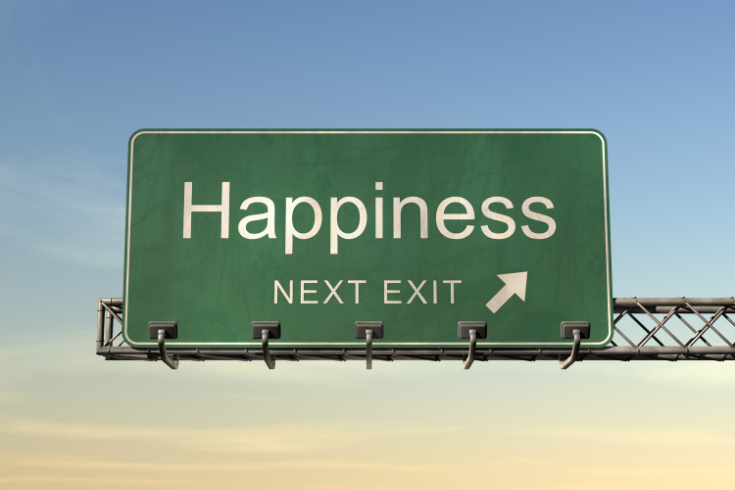
Emotionally: When happiness becomes a test you can fail
A growing body of research shows that valuing happiness too highly can actually make people less happy.
Iris Mauss and colleagues1 found that people who strongly believe they must feel happy tend to report lower life satisfaction, more negative emotion, and more depressive symptoms – the exact opposite of what they’re aiming for.
The pursuit of happiness – especially the pressure to be visibly happy – can carry some very real emotional, physical, and psychological costs.
Other studies2 suggest that this intense focus on being happy is linked with greater loneliness, particularly under stress, because it makes us more self-focused and less open to messy, real connection.
Add to that the problem of toxic positivity – the cultural message that you should “look on the bright side” no matter what. Psychologists describe toxic positivity as the pressure to avoid or suppress difficult emotions, which can leave people feeling invalidated, ashamed of their sadness, and emotionally isolated3.
So emotionally, the cost of “I must be happy” can look like guilt or shame when you’re not happy ‘enough’; loneliness because you can’t be honest about your feelings; feeling like a failure at something that’s supposed to be natural.
Physically: your body picks up the bill
The body doesn’t just shrug off emotional pressure. When we force ourselves to look fine and suppress how we really feel, the nervous system has to work overtime.
Gross and Levenson4 show that suppressing emotional expression (keeping a “brave face”) increases sympathetic nervous system activation – things like heart rate and blood pressure – compared with simply allowing emotions to show.
In short: happiness itself isn’t the problem.
The problem is when happiness becomes an obligation, a performance, or a personal KPI. The science is pretty clear: when we demand constant happiness, suppress anything that doesn’t fit the script, and judge ourselves for feeling human, we pay for it – with our bodies, our minds, and our relationships.
The science is pretty clear: when we demand constant happiness, suppress anything that doesn’t fit the script, and judge ourselves for feeling human, we pay for it – with our bodies, our minds, and our relationships.
What mindfulness adds to the discussion
If there’s one group of people who would absolutely not encourage you to plaster a festive grin across your face, it’s those with a deep understanding of human thought and behaviour which includes a mindfulness perspective.
Their collective wisdom, from the clinical to the contemplative, offers a refreshing antidote to the “Be Happy at All Times” doctrine: namely, that happiness is not a performance, nor is it a requirement.
Presence, not perkiness
Mindfulness teachers such as Jon Kabat-Zinn remind us that mindfulness has never been about feeling good; it’s about being present with what’s true. From this perspective, forcing yourself to be happy is just another form of resistance.
Mindfulness suggests instead that we simply notice what’s here: pleasure, discomfort, boredom, sadness, relief… all of it welcome at the table.

Happiness runs when you chase it
In mindfulness traditions, happiness is understood not as an achievement but as a side-effect of awareness. Thich Nhat Hanh wrote often about the futility of trying to manufacture joy. The more you try to “make yourself happy,” the more stressed and self-conscious you become5.
Mindfulness doesn’t promise constant happiness; it offers something sturdier. It teaches us to meet our inner world with honesty and kindness, instead of wrestling it into a festive smile.
Suppressing difficult emotions is bad for body and mind
Modern mindfulness research warns against emotional suppression – the classic “I’m fine” while your nervous system is quietly staging a revolution. Suppression increases anxiety, tension, blood pressure, and leads to avoidance behaviours.
Mindfulness offers a gentler, more biologically sane alternative: acknowledge emotions as they arise (“sadness is here,” “stress is here”). This simple naming process reduces the physiological burden of pretending and allows the nervous system to settle naturally, rather than fight a losing battle against reality.
Emotions are weather, not permanent fixtures
Mindfulness traditions famously describe emotions as passing weather.
The problem isn’t sadness or frustration; it’s the belief that these states are somehow failures or permanent. Instead of “I should be happy”, mindfulness offers a more forgiving frame: emotions arise, peak, and dissolve at their own pace. Happiness is less a trophy and more a visitor – one who tends to arrive more often when you’re not anxiously tidying up the house.

Less judging, more kindness
One of the most liberating insights from mindfulness teachers like Tara Brach is that the real suffering often comes not from the emotion itself but from the judgement we heap on top of it: “I shouldn’t feel like this.” “Everyone else is coping better.” “Why can’t I just be happy?”
Mindfulness softens these attacks with self-compassion, making room for contentment to grow – not the shiny, Instagrammable kind, but the deeper kind that comes from treating yourself like a human being rather than a malfunctioning happiness machine.
This shift reduces the psychological cost of negative emotion without the unrealistic expectation of eliminating it.
Mindfulness doesn’t promise constant happiness; it offers something sturdier. It teaches us to meet our inner world with honesty and kindness, instead of wrestling it into a festive smile.
Being kind is a legitimate, science-backed route to well-being and connection – far more sustainable (and morally comforting) than trying to maintain a forced holiday grin 24/7.
A kinder route to happiness
After all this talk about the pressure to appear deliriously, seasonally, photographically happy, it’s worth ending with something gentler – and far more humane.
Because while trying to act happy can be emotionally, physically, and psychologically exhausting, doing something kind appears to do the opposite.
A growing body of research shows that small acts of kindness – whether carefully planned or wonderfully random – can actually lift our mood, calm our nervous system, and strengthen our sense of connection with others.
A large meta-analysis of 27 studies6 found that performing acts of kindness reliably increases our subjective well-being. Not by turning us into hyperactive fountains of cheer, but by creating small, meaningful boosts in mood and belonging. Other studies show that kindness is associated with higher optimism, resilience, and flourishing, as well as lower loneliness and anxiety. Even simply observing a kind act can improve well-being.
Psychologists and neuroscientists suspect this is partly due to the activation of reward pathways in the brain – dopamine, oxytocin, the warm sense of social bonding – and partly due to the simple fact that kindness grounds us in relationship. It pulls us out of self-monitoring (“Am I happy yet?”) and into something more outward-focused, more human, more nourishing.
And importantly, these acts don’t need to be grand, dramatic, or festival-ready. Everyday kindness counts like letting someone go ahead in a queue; offering a sincere compliment; giving someone a moment of your time and patience they weren’t expecting; quietly helping someone navigate a busy supermarket aisle full of panicked holiday shoppers.

Even giving a small, thoughtful gift can have the same well-being effect – not because the recipient is overwhelmed with joy, but because we experience a sense of prosocial purpose and connection.
In other words, being kind is a legitimate, science-backed route to well-being and connection – far more sustainable (and morally comforting) than trying to maintain a forced holiday grin 24/7.
Perhaps the real festive spirit isn’t compulsory cheerfulness, but these small, unpolished, unadvertised moments of generosity and care – the quiet kind of happiness that doesn’t need to be performed, photographed, or proven.
A gentle closing thought
Whether you’re celebrating this season or letting it pass quietly. Whether you’re surrounded by people or navigating it on your own. Whether you’re feeling festive, flat, or somewhere in between… there is no requirement to glow with constant happiness.
Instead, you might simply practise the small things that mindfulness and research both point us toward – pausing, noticing, softening, connecting, and offering kindness in whatever ways are real for you. A moment of presence. A breath. A kind gesture. A message to someone you care about. A gentle word to yourself. None of these demand a particular emotional state; they just invite you to be here, fully and honestly.
And so, as this season unfolds in all its beauty and chaos, our hope for you is simple:
May you find moments of connection, kindness, and genuine presence – whatever they look like for you. And may those moments move you a little closer to the kind of happiness that doesn’t need to be performed, only lived.
References
- 1https://pmc.ncbi.nlm.nih.gov/articles/PMC3160511/
- 2https://www.researchgate.net/publication/51631109_The_Pursuit_of_Happiness_Can_Be_Lonely
- 3https://www.psychologytoday.com/gb/basics/toxic-positivity
- 4https://pubmed.ncbi.nlm.nih.gov/9103721/
- 5https://www.goodreads.com/work/quotes/959684-the-art-of-power-a-zen-master-s-guide-to-redefining-power-achieving-tr
- 6https://www.sciencedirect.com/science/article/pii/S0022103117303451