

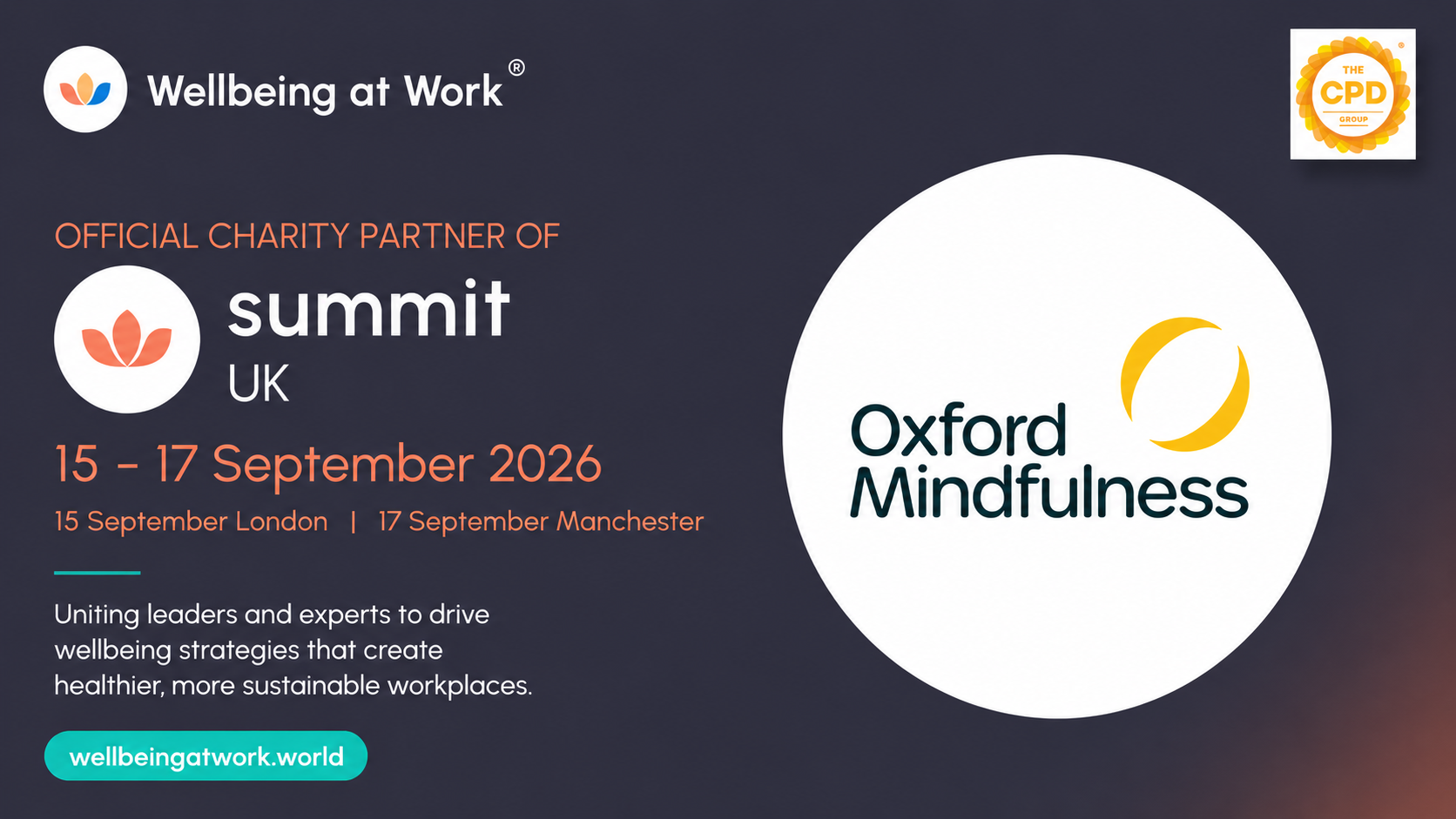
I’m delighted to announce that Oxford Mindfulness will be the official charity partner for the Wellbeing at Work UK Summits 2026 in London and Manchester.
The Wellbeing at Work Summit brings together senior leaders, HR professionals, well-being specialists, researchers, and organisational decision makers who share a common goal: creating healthier, more sustainable workplaces where people and organisations can thrive. As workplace well-being becomes ever more prominent on the organisational agenda, the Summit provides an opportunity to share learning, explore emerging challenges, and discuss practical approaches for supporting people at work.
Why well-being at work matters
Most of us spend a significant amount of our time at work. The quality of our working environment, relationships, leadership, and organisational culture can have a real impact on our physical health, mental well-being, motivation, and performance.
I’ve been studying this area for the last 15 years and have seen workplace well-being move from being viewed as a “nice-to-have” to becoming an important strategic priority. With more and more evidence emerging, employers are increasingly recognising that supporting employee well-being is not only the right thing to do, but is linked to engagement, retention, productivity, creativity, and long-term organisational success.
Last year at the Summit there was a wealth of data, case studies, and practical examples shared on the impact of well-being initiatives in these areas. It reinforced why so many major organisations were in attendance and investing significant time and energy into this agenda.
Often, CPD credits are required by employers, professional bodies, registration organisations, or accreditation frameworks. Providing a valuable way of recognising and documenting relevant learning that supports both personal and professional growth.
Acknowledging the challenges
However, I do acknowledge the challenges. Rapid technological change, economic uncertainty, increasing workloads, and the blurring of boundaries between work and personal life, often accelerated by flexible and hybrid working, can leave people feeling stretched and overwhelmed. Well-being initiatives can sometimes feel like an added burden for both employers and employees when they are not carefully co-created with the people they are intended to support.
I’m always keen to stress that creating healthy workplaces is not simply about reducing stress. It’s about helping people develop the awareness, skills, and supportive environments that enable them to respond more effectively to the demands of modern working life.
Well-being is about more than mental health
I attended the Wellbeing at Work UK Summits last year as a delegate and was struck by the breadth of topics being discussed. Of course, mental health remains an important focus, but the conversations extended well beyond this, reflecting a growing recognition that well-being is influenced by many interconnected factors.
Sessions explored topics such as leadership, organisational culture, sleep, menopause, nutrition, social connection, and how employers can support healthy habits and lifestyles. What particularly stood out for me was how many of these discussions reflected a broader understanding that health and well-being are influenced by multiple interconnected factors rather than any single intervention.
There was a clear recognition that supporting well-being is not simply about helping people cope when things become difficult, but about creating psychologically safe environments and encouraging behaviours that help people stay well in the first place.
Last year’s programme brought together senior leaders from global organisations, HR and well-being professionals, researchers, clinicians, entrepreneurs, and people with lived experience, all contributing different perspectives to the conversation. I left the event really impressed and heartened by the number of organisations taking meaningful action in this area.
As a charity dedicated to increasing access to research-based mindfulness, we’re excited to contribute to conversations about prevention, resilience, leadership, and the role that awareness and behaviour change can play in supporting healthier workplaces.
No longer niche
Workplace well-being is no longer viewed by many organisations as a niche topic or an optional extra. Seeing so many leaders investing time, energy, and resources into this agenda gave me real optimism about the direction of travel and reinforced my sense that Oxford Mindfulness has an important role to play in supporting this work.
As I listened to the discussions last year, I could hear how closely many of the themes aligned with our work at Oxford Mindfulness, but I also learned that some of our approaches were not always fully aligned with what organisations and employees were looking for. I found that really valuable.
It was one of those events where I genuinely felt there was a shared goal. People were keen to learn from one another and willing to openly discuss business strategies, successful initiatives, and approaches that had not worked as expected. That level of openness and collaboration is rare and refreshing.
I left feeling grateful for the experience and keen to engage more closely with the Wellbeing at Work team to advance our shared ambitions.
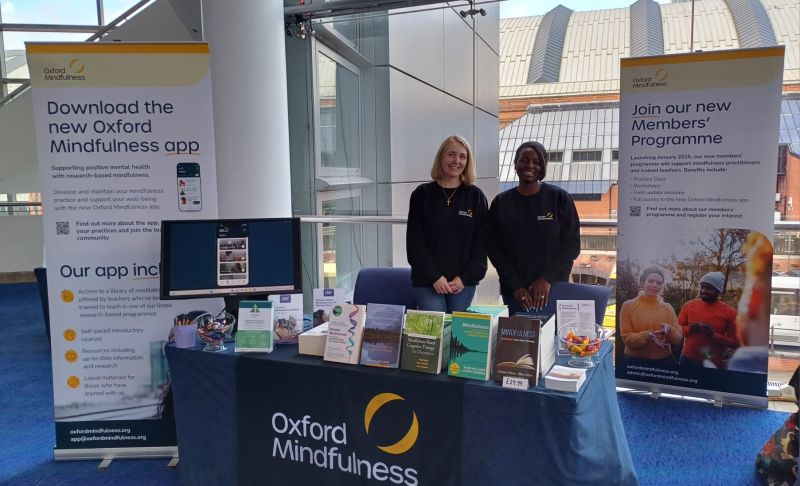
Image: Oxford Mindfulness table at previous event
Looking forward to the 2026 Summits
I’m therefore particularly pleased that Oxford Mindfulness will be the official charity partner for the Wellbeing at Work UK Summits in 2026. These events provide a valuable opportunity to learn from others, share evidence informed approaches, and contribute to the vision of supporting people not only to perform well at work, but to stay well too.
As a charity dedicated to increasing access to research-based mindfulness, we’re excited to contribute to conversations about prevention, resilience, leadership, and the role that awareness and behaviour change can play in supporting healthier workplaces.
I look forward to meeting delegates, learning from the speakers and organisations in attendance, and sharing how mindfulness can help people navigate the opportunities and challenges of work in the modern world.
We’ll have a table at the event and be in the communal areas, I’m really looking forward to seeing many of my fellow workplace well-being colleagues there, continuing to learn from one another, and sharing more about our work at Oxford Mindfulness as we collectively advance this important agenda.
Come and see us at the Wellbeing at Work Summits UK 2026
Tuesday 15 September 2026, London
08:00-17:00 UK Time | The University of Chicago Booth School of Business
Thursday 17 September 2026, Manchester
08:00-17:00 UK Time | Manchester Metropolitan University